Wikiparfum
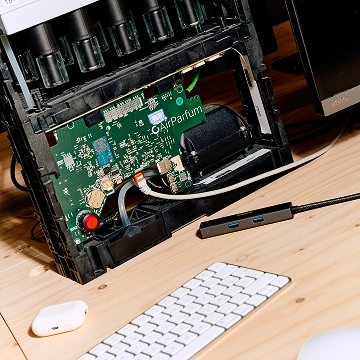
Puig had the world's best fragrance data. We turned it into a platform.
An API, short for Application Programming Interface, is a defined set of rules that lets one software system talk to another. It states what requests can be made, how to format them, and what responses come back. None of the internals are exposed. The API is a contract, and as long as both sides honour it, each system can change underneath without breaking the other.
APIs are the connective tissue of modern software. They let applications share data and functionality across platforms and organisations. When a mobile app shows live weather, runs a payment, or logs someone in through their Google account, an API is doing the work behind the scenes. The patterns differ: REST and GraphQL cover most web APIs today, SOAP still lingers in enterprise systems, and SDKs wrap APIs in language-specific tooling that is easier to consume.
From a product angle, a well-designed API keeps systems modular and extensible. Teams build on what already exists instead of rewriting it, and third parties can connect to a platform in ways its original authors never planned for. That is why API design choices made early tend to shape what a product can become later.
Most of what we build connects to something else. Payment providers, mapping services, CRMs, CMSs, internal tools a client already runs. We treat the API as a contract from day one and design it so the parts can evolve without forcing a rewrite every time a dependency shifts.
API integration work rarely starts clean. A partner hands us a third-party system with thin docs and odd edge cases, and we map it, wrap it, and make it behave. We have done this for global brands with messy legacy stacks and for products being built from scratch. When an API we depend on changes, we own the fallout and keep the rest of the system running.
Got systems that need to talk to each other? Let's connect them properly.
Puig had the world's best fragrance data. We turned it into a platform.
A logistics company that ships to 190 countries built something to ship to itself.
Half a million people. One app. Zero chaos.