Wikiparfum
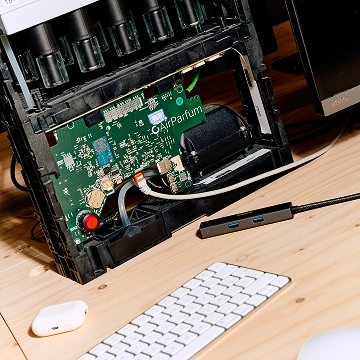
Puig had the world's best fragrance data. We turned it into a platform.
An embedding is a way of representing data as a vector, a list of numbers, so that similar things end up with similar numbers. A model trained on huge amounts of text learns to place words, sentences, or documents as points in a high-dimensional space where distance reflects meaning.
The useful property is that geometry now stands in for semantics. "Cat" and "kitten" land near each other. "Cat" and "spreadsheet" land far apart. Because meaning becomes math, you can compare two pieces of text by measuring the distance between their vectors, cluster related items, or find the closest match to a query. Product recommendations that surface items "like this one," computed by comparing embeddings rather than tags, are this idea in everyday use. Embeddings exist for images and audio too, not only text.
Embeddings are the foundation under semantic search, RAG, classification, and recommendation systems. They are what a vector database actually stores, and they are how a model turns messy human content into something a machine can compare at scale.
Embeddings show up in most of the AI work we ship, usually behind the scenes. Choosing the right embedding model, deciding what gets embedded and at what granularity, and checking that similar things actually land close together. Get this layer wrong and everything built on top of it feels subtly broken, so we measure retrieval quality early and adjust.
This sits inside our AI and machine learning solutions, and it overlaps with predictive analytics and machine learning when embeddings feed classification or recommendation models. We design the pipeline that keeps embeddings fresh as content changes, because a vector computed last quarter stops reflecting reality. The aim is a representation your application can trust, not a one-off experiment.
Want recommendations or search that understand your content? Let's build the foundation.
Puig had the world's best fragrance data. We turned it into a platform.
A logistics company that ships to 190 countries built something to ship to itself.
Half a million people. One app. Zero chaos.