Wikiparfum
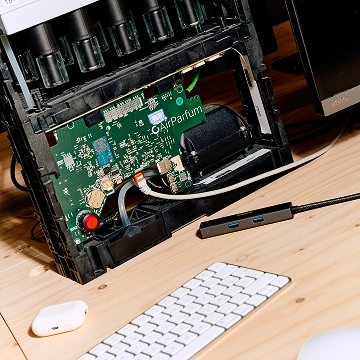
Puig had the world's best fragrance data. We turned it into a platform.
Full-stack means working across the entire technical stack of an application, both the front end people see and the back end they do not. The front end is the interface in the browser. The back end is the server, the database, and the logic behind it. A full-stack developer or team works on all of it rather than one slice.
The "stack" is the set of technologies layered together to make a product run: the language and framework on the server, the database storing the data, the APIs connecting things, and the HTML, CSS, and JavaScript rendering the interface. Being full-stack does not mean being equally expert in every layer. It means understanding how they fit so a feature can be carried from the database to the screen without handing off across a wall. When a user submits a form and expects an instant confirmation, someone has to design the input, write the API that receives it, store it correctly, and reflect the result back in the interface. Full-stack work treats that as one connected problem instead of four disconnected ones.
The value is in the seams. Many of the hardest bugs and slowest features live in the gaps between front end and back end, and those gaps are exactly what a full-stack view closes.
We work full-stack because the interesting problems usually live where the layers meet. A slow page is rarely just a front-end issue or just a database issue. Owning the whole path, from the data model to the rendered screen, means we can fix the actual cause instead of pushing the problem to the next team.
That breadth shapes how we partner. A client does not have to coordinate a separate front-end shop and back-end shop and hope the two agree. Our web development and custom web application work spans the stack, so a feature is one conversation and one team from idea to shipping. When something breaks, there is no finger-pointing across a boundary, because the boundary is ours to own.
Need one team that owns the whole product, front to back? Let's talk.
Puig had the world's best fragrance data. We turned it into a platform.
A logistics company that ships to 190 countries built something to ship to itself.
Half a million people. One app. Zero chaos.