Wikiparfum
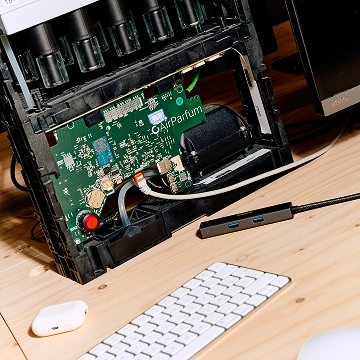
Puig had the world's best fragrance data. We turned it into a platform.
Git is a distributed version control system created by Linus Torvalds in 2005. It tracks changes to files over time and lets many people work on the same codebase at once without overwriting each other's work. Distributed means every contributor holds a full copy of the project history, not just a link to a central server.
The unit of history in Git is the commit. Each one records what changed, who changed it, and when, which turns the codebase into a timeline you can read backwards. That history is what makes it possible to find the exact change that introduced a bug, review how a feature came together, or revert to a known-good state when something breaks. Branching extends this further. A developer can open a branch to build a feature in isolation, then merge it back once it is ready, so unfinished work never destabilises the main code. When two people edit the same file, Git flags the conflict and asks a human to resolve it rather than guessing.
Platforms like GitHub, GitLab, and Bitbucket build on top of Git, adding code review, issue tracking, and automated pipelines to the version control core. Git is the engine underneath; those platforms are the collaboration layer most teams interact with daily.
Git is the spine of how we work. Every change runs through a branch and a review before it reaches the main code, so nothing lands without another set of eyes on it. That history also keeps us honest with clients, because the record of what changed and why is always there to check.
It connects directly to our CI/CD pipelines, where a push triggers automated checks and, once they pass, a clean path to deployment. The discipline Git enforces is what lets us move fast without breaking the things already in production.
Want a codebase with a clear history and a calm release process? Let's build it that way.
Puig had the world's best fragrance data. We turned it into a platform.
A logistics company that ships to 190 countries built something to ship to itself.
Half a million people. One app. Zero chaos.