Wikiparfum
Puig had the world's best fragrance data. We turned it into a platform.
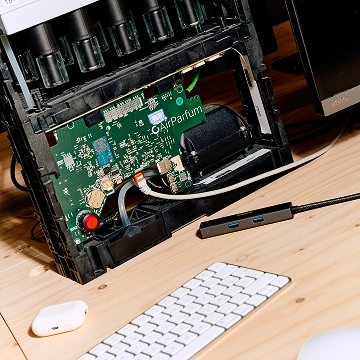
A Raspberry Pi is a single-board computer the size of a credit card. A full system on one board: processor, memory, USB, networking, and a row of GPIO pins for wiring up sensors and hardware. It runs a real Linux operating system, so the same languages and tools you use on a server run here too. Cheap enough to buy a dozen and treat them as disposable.
That combination made it a staple of IoT applications, hardware prototyping, and physical computing. A Pi can read a temperature sensor and push the value to the cloud, drive a screen in a retail window, or act as the brain of a kiosk. An interactive museum exhibit that responds to motion and triggers video is a textbook job for one. It is a general-purpose Linux machine, which sets it apart from a microcontroller like an Arduino. The Arduino is better at tight real-time control of pins. The Pi is better when you need a network stack, a file system, and the freedom to run normal software.
The tradeoffs are real. A Pi is not built for harsh industrial duty out of the box, SD card storage can wear out, and power loss can corrupt a running system if you do not plan for it. For prototypes, installations, and small fleets, the price-to-capability ratio is hard to beat.
We use Raspberry Pi where software meets the physical world. Interactive installations that react to people in a space. Sensor nodes for IoT development that report back to a dashboard. Quick hardware prototypes that prove an idea before anyone commits to custom electronics.
The honest version is that a Pi is a starting point, not always the finished product. We build the firmware, the connectivity, and the cloud side that turns a board on a bench into something that survives an event or a deployment. When a project needs to scale past a handful of devices, we talk through whether a Pi fleet or purpose-built hardware is the right call. Either way, the brief is the same. Make it reliable enough to leave running when no one is watching.
Got an idea that lives in the real world, not just a browser? Let's prototype it.
Puig had the world's best fragrance data. We turned it into a platform.
A logistics company that ships to 190 countries built something to ship to itself.
Half a million people. One app. Zero chaos.