Wikiparfum
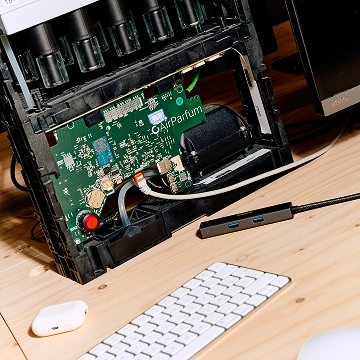
Puig had the world's best fragrance data. We turned it into a platform.
SolidJS is a JavaScript library for building user interfaces. It looks a lot like React, with JSX and components, but the engine underneath is completely different. Solid uses fine-grained reactivity and skips the virtual DOM entirely. The result is among the fastest rendering performance of any frontend library.
The key difference is when components run. A React component re-runs its whole function every time its state changes, then diffs the output against a virtual DOM. A Solid component runs once. After that, only the precise pieces of the DOM that depend on a changed value update, tracked through reactive signals. A live dashboard where a single number ticks every second updates exactly that number, not the surrounding tree. This is the same reactivity philosophy as Svelte, but Solid does it at runtime with signals rather than at compile time, and it keeps JSX and a React-like authoring style.
Against React, Solid trades a vast ecosystem for raw speed and a smaller footprint. Against Svelte, it offers a more familiar React-flavored API and a runtime-based model. The cost is maturity. Solid is younger, so the library ecosystem and the hiring pool are smaller than React's, which is a real consideration on a long-lived product.
We reach for SolidJS when interface performance is the whole point. Dense dashboards, real-time data views, anything with frequent fine-grained updates where React's re-render cycle becomes the bottleneck. The reactivity model maps neatly onto that kind of work.
We are clear-eyed about the tradeoff. A smaller ecosystem means more things we build ourselves and a smaller talent pool to maintain it later, so we only recommend Solid when the performance gain is worth that. For most web development we still default to the React ecosystem because the surrounding tooling is deeper. When the numbers justify Solid, we make that call with the client, not for them, and we document it so the next team understands why.
Building an interface that has to stay fast under constant updates? Let's talk.
Puig had the world's best fragrance data. We turned it into a platform.
A logistics company that ships to 190 countries built something to ship to itself.
Half a million people. One app. Zero chaos.